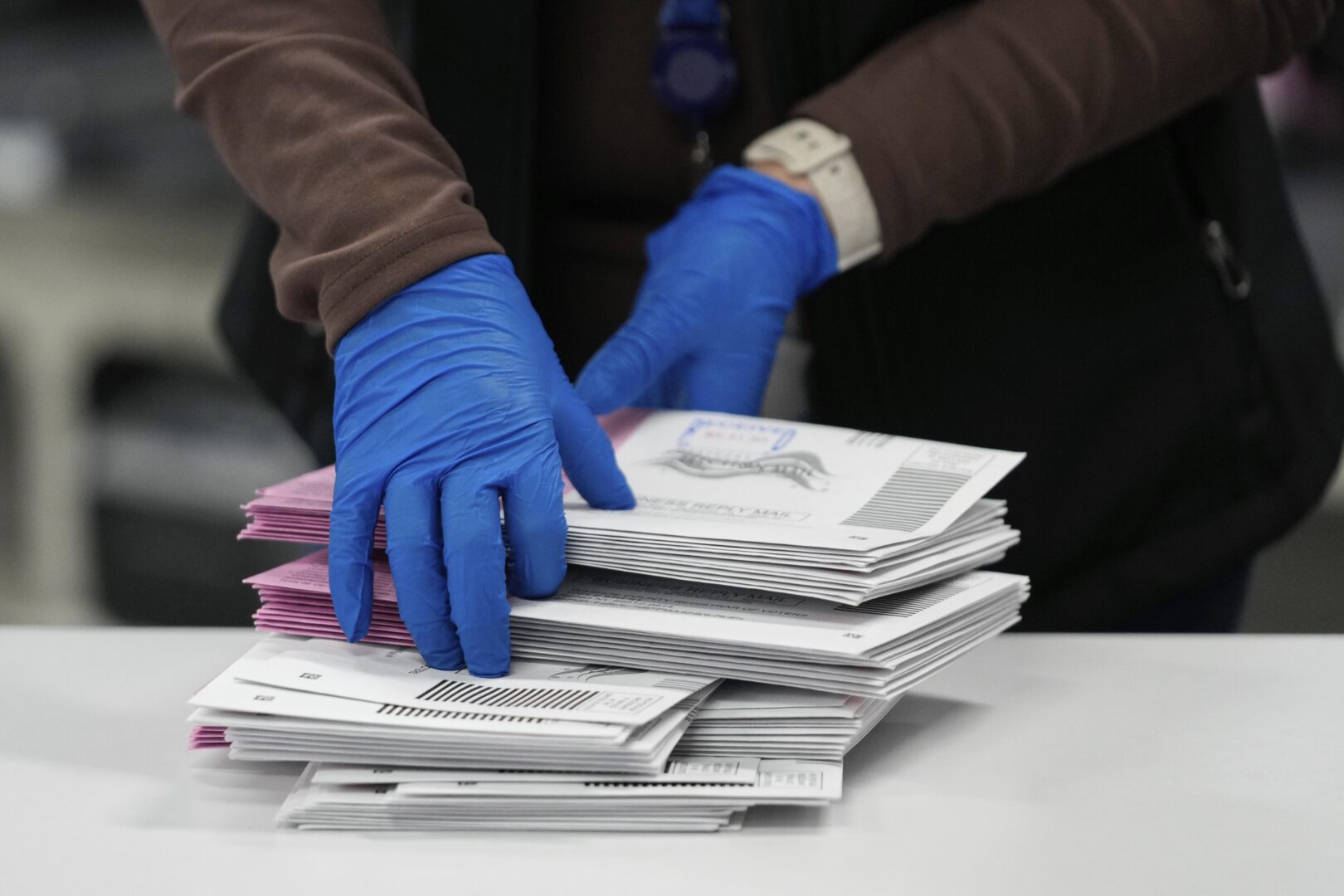
In this file photo, an election worker sorts mail-in ballots in Reno, Nev., on Nov. 5, 2024.
Godofredo A. Vásquez / AP

In this file photo, an election worker sorts mail-in ballots in Reno, Nev., on Nov. 5, 2024.
Godofredo A. Vásquez / AP
Godofredo A. Vásquez / AP
In this file photo, an election worker sorts mail-in ballots in Reno, Nev., on Nov. 5, 2024.
Pennsylvania, a crucial swing state, is often the subject of election-related misinformation. In July, President Donald Trump falsely claimed in a nationally televised address that “hundreds of thousands of non-citizens and dead people are listed and active on voter rolls” in several Democratically controlled states. His Department of Homeland Security followed up with a letter to Pennsylvania’s Department of State claiming there are 14,576 potential noncitizens on the voter rolls, but the Trump administration hasn’t provided the names. In California and Washington, where DHS did provide names, election officials said the data was unreliable.
These latest claims come on the heels of years of false and misleading statements by Trump and his supporters about migrants illegally registering to vote in large numbers, about voter rolls still having the names of dead people, about why it sometimes takes time to count votes, and about voting machine security.
While voter fraud does occur, it’s rare, usually isolated, and election officials have safeguards to catch it. The public does, too.
Charles Stewart III, political science professor at MIT, researches how elections are run. The more people watching elections, the more secure they are.
“The most important way of catching anomalies, which are inevitably mistakes, are through just a million eyes on the whole process, from the voters using the equipment and reporting that things aren’t working, to the media, campaigns, the public, eyeing the election results, and pointing out when things look squirrely,” Stewart said.
Fixing any anomalies should happen through the election certification process, which requires extensive reviews and audits, and in formal legal proceedings, Stewart said. Evidence submitted in court must hold up to scrutiny and testimony needs to be accurate, upon pain of perjury. Claims about election fraud pursued outside formal proceedings, or after being rejected in courts, could indicate bad faith.
Here’s a closer look at the facts.
The specter of immigrants voting illegally in the U.S. has become a leading election-year talking point for Republicans and is again during Trump’s second administration. But voting by people who are not U.S. citizens already is illegal in federal elections and there is no indication it’s happening anywhere in significant numbers. And Pennsylvania, like many states, prohibits noncitizens from voting in elections for state offices.
A 1996 federal law allows fines and imprisonment for up to a year for noncitizens who vote in federal elections. Violators can also be deported. When people in the U.S. register to vote, they swear under penalty of perjury that they are U.S. citizens.
In Pennsylvania, only people who meet various requirements, including citizenship, can register to vote. Under the state constitution, a voter must “have been a citizen of the United States at least one month,” in addition to meeting state and voting district residency requirements.
Pennsylvania’s Republican Auditor General, Timothy DeFoor, reviewed a six-month sample of Automated Voter Registration data from 2024. Out of 210,000 registrations, one ineligible person was given an application to register, and it was a clerical error. The person was removed from the rolls and never voted, according to the report released earlier this year.
Reputable nonpartisan groups regularly review noncitizen voting and find each time that it’s incredibly rare. Even the highly partisan and conservative Heritage Foundation’s Election Fraud Map lists only a total of 45 voter fraud cases of any kind between 1982 and 2025, with 15 relating to false registration or ineligible voting.
Since September, the Trump administration has charged 20 people with noncitizen-voting-related crimes in Pennsylvania, as reported by Votebeat. That’s out of nine million registered voters. Compared to the more than seven million voters who cast ballots in 2024, those 20 charges represent less than 0.0003% of votes cast. Additionally, those charged remain innocent until proven guilty, not all the charges were for alleged violations in 2024 or for actually voting, and their court proceedings won’t occur until after the election, making the potential impact even smaller.
Pennsylvania does have a history of some noncitizens being registered to vote, but it was the state’s fault. In 2017, Pennsylvania acknowledged it had to fix a glitch that allowed noncitizen immigrants to register to vote when getting a driver’s license. At one point, state election officials said noncitizen immigrants may have cast 544 ballots illegally — out of more than 93 million ballots in elections spanning 18 years, going back to 2000.
Election officials are constantly looking over voter rolls, according to Lebanon County election director Sean Drasher. In his experience, when there’s a noncitizen on the voter rolls, it’s administrative error, he said. And he’s never seen a registered noncitizen cast a vote.
“It’s not nefarious fraud that’s happening,” Drasher said. “It’s clumsy bureaucracy that created that situation that we’ve now cleaned up.”
And it’s not just election officials looking out for people on the voter rolls when they shouldn’t be. It’s become a hot issue for district attorneys.
“They are hungry for this kind of stuff, and they’re eager to find these cases. But the problem is, there aren’t many cases to find,” Drasher said.
Pennsylvania is among 17 states that have statutes that either prohibit counting absentee ballots that were submitted by voters who die before Election Day or allow those ballots to be challenged, according to the National Conference of State Legislatures. Eleven states have laws that explicitly allow counting absentee ballots cast by voters who die before Election Day.
County election officials in Pennsylvania regularly update their voter registration lists when voters die. The Pennsylvania Department of Health transmits data on resident deaths to the Pennsylvania Department of State, and counties use that data to remove deceased individuals from their voter rolls.
“There’s no way to die in this country without getting a death certificate,” Drasher said.
Pennsylvania law allows counties to use information from the health department, published obituaries, and testamentary documents to confirm that a voter has died. In Lebanon, Drasher has an elections clerk whose job it is to process the death certificates, and she also checks the obituaries. Sometimes it takes a couple days to get the certificates, but they’re usually processed within an hour of coming in, Drasher said.
“The door closed on that issue forever ago,” Drasher said, but added that one-off “freak show” incidents still happen.
In 2021 a Pennsylvania man who illegally voted for Donald Trump on behalf of his long-dead mother in the 2020 election was sentenced to five years of probation.
In past elections, false and misleading claims have focused on the time it takes Pennsylvania counties to count votes. But such claims misrepresent why the process is relatively slow.
Under Pennsylvania law, elections officials must wait until 7 a.m. ET on Election Day before they can begin to process ballots cast by mail and prepare them to be counted. The release of mail voting results cannot begin until after polls have closed. Because of the overall volume of mail ballots — they comprised almost a quarter of the total vote in the 2022 midterm elections — and the varying amounts of time it takes the state’s 67 counties to tally these votes, determining a winner in a highly competitive race could take several days, as it did in the 2020 presidential election.
No-excuse by mail voting was passed in Pennsylvania in 2019, and the 2020 election was the first time county officials ran elections with large numbers of mail-in ballots and did so during a pandemic. In the six years since, counties have bought equipment, sometimes with state funding, that helps organize and process mail-in ballots. That includes high-speed sorters and envelope openers.
Dauphin County’s election director, Chris Spackman, said he expects the county to be ready to tabulate then upload results from mail-in ballots received before Election Day when polls close. That should be a common experience in election offices across the state, meaning the first wave of results will likely lean heavily Democratic, as Democrats are returning mail-in ballots at a 3-to-1 pace compared to Republicans.
No matter how quickly mail-in ballots are counted, Pennsylvania will take 21 days to officially certify the election, by law. That allows the county to count mail-in ballots received on Election Day, military ballots voted by Election Day but received up to a week after, investigate and count approved provisional ballots, perform several audits of the process and machine counts, resolve any legal challenges, and perform recounts if required. Any vote totals reported before certification are unofficial.
This story was originally published as part of a 2024 explanatory series focused on Pennsylvania elections, produced collaboratively by WITF and The Associated Press. WITF updated the story to accurately reflect information for 2026.

Member support provides the foundation we rely on to connect our community with trusted journalism. Support WITF’s Fall Membership Campaign today.