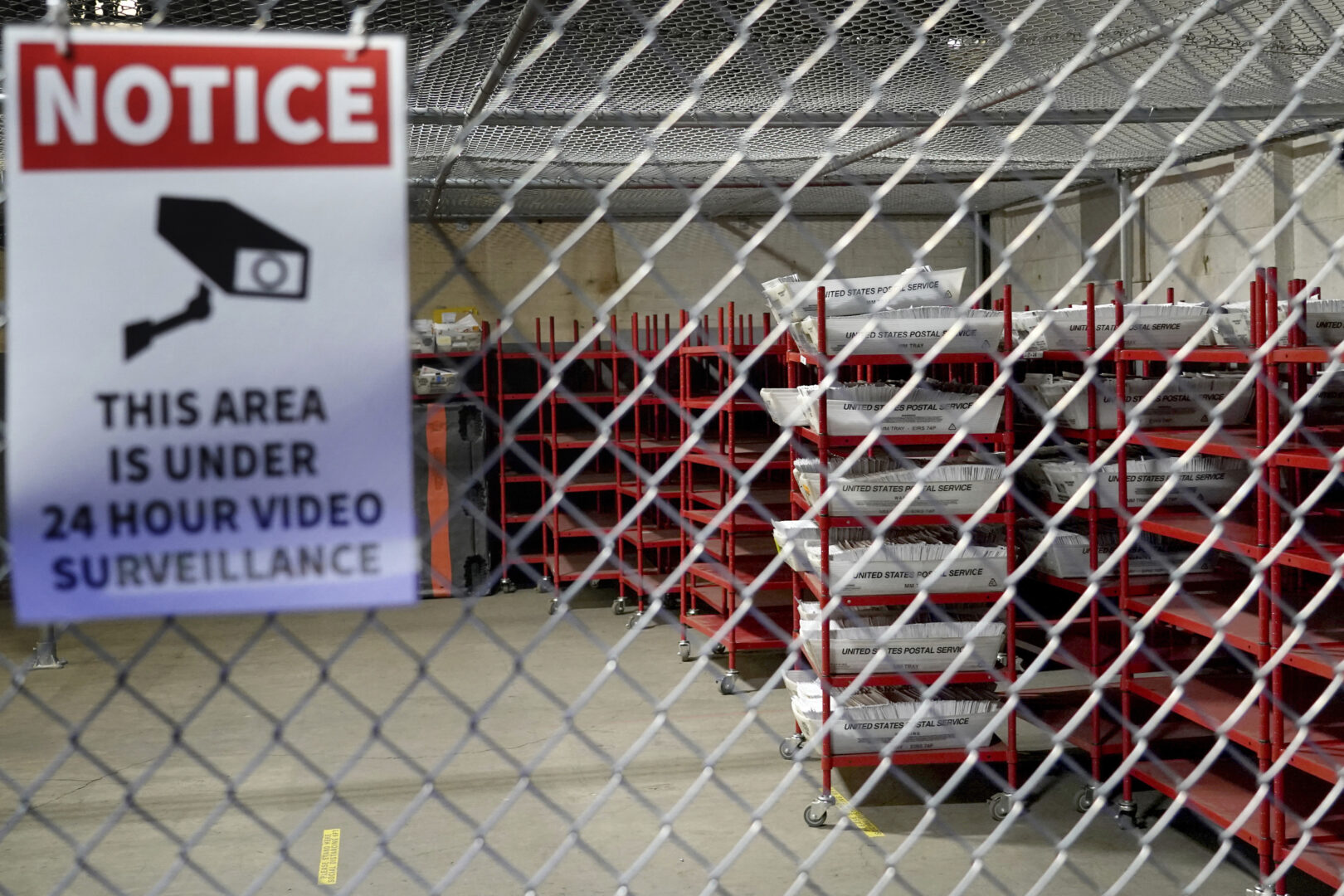
Mail-in ballots sit in a secure area of the the Allegheny County Elections Division warehouse, Wednesday, Oct. 30, 2024, in Pittsburgh. (AP Photo/Matt Freed)

Mail-in ballots sit in a secure area of the the Allegheny County Elections Division warehouse, Wednesday, Oct. 30, 2024, in Pittsburgh. (AP Photo/Matt Freed)
Mail-in ballots sit in a secure area of the the Allegheny County Elections Division warehouse, Wednesday, Oct. 30, 2024, in Pittsburgh. (AP Photo/Matt Freed)
Police escorts, sealed containers and chain of custody documentation: These are some of the measures that Pennsylvania counties take to secure ballots while they are transported from polling places to county facilities after polls close on Election Day.
The exact protocols vary by county. For instance, in Dauphin County, election judges will transport ballots in sealed boxes back to the county elections office, according to Chris Spackman, director of elections.
In Philadelphia, local law enforcement plays a direct role in gathering ballots from polling places.
“Philadelphia police officers will travel to polling places across the city after the polls close and collect those ballots to be transported back to our headquarters at the end of the night,” said Philadelphia City Commissioner Seth Bluestein, who serves on the board that oversees elections in the city. “Each precinct is given a large canvas bag, and the containers that hold the ballots are placed into that bag and transported by the police.”
After polls close in Allegheny County, which includes Pittsburgh, poll workers will transport ballots in locked, sealed bags to regional reporting centers, where the election results are recorded, said David Voye, division manager of the county’s elections division.
From there, county police escort the ballots to a warehouse where they are stored in locked cages that are under 24-hour surveillance.
Poll workers and county election officials also utilize chain of custody paperwork to document the transfer of ballots as they are moved from polling places to secure county facilities.
For instance, in Allegheny County, chain of custody forms are used to verify how many used and unused ballots poll workers are returning to county officials, Voye said. Officials also check the seals on the bags used to transport the ballots to confirm that they are still intact.
There are similar security procedures for counties that use ballot drop boxes to collect mail and absentee ballots. In Dauphin County, law enforcement officers monitor the county’s drop zones during the day, according to Spackman, and can be involved in the chain of custody.
“It never leaves physical control on election night from the judge of elections to the drop zone then to our office,” he said. “It’s always in the personal custody of election officers or law enforcement.”
Officials remove the ballots, count them, record the number of ballots on a custody sheet, and put the ballots in a sealed box before they transported back to the county’s processing center.
“You have multiple different sources of redundancies,” Spackman said.
Philadelphia has 34 ballot drop boxes, which are emptied daily and twice on Election Day by election workers, according to Bluestein. The bags used for transporting ballots from drop boxes are also sealed, and workers who are returning these ballots complete and sign a chain of custody form.
“The transportation of ballots is done in a secure, controlled manner, and the public should have confidence in the integrity of that ballot collection process,” Bluestein said.
This story was originally published as part of a 2024 explanatory series focused on Pennsylvania elections, produced collaboratively by WITF and The Associated Press. WITF updated the story to accurately reflect information for 2026.

Member support provides the foundation we rely on to connect our community with trusted journalism. Support WITF’s Fall Membership Campaign today.