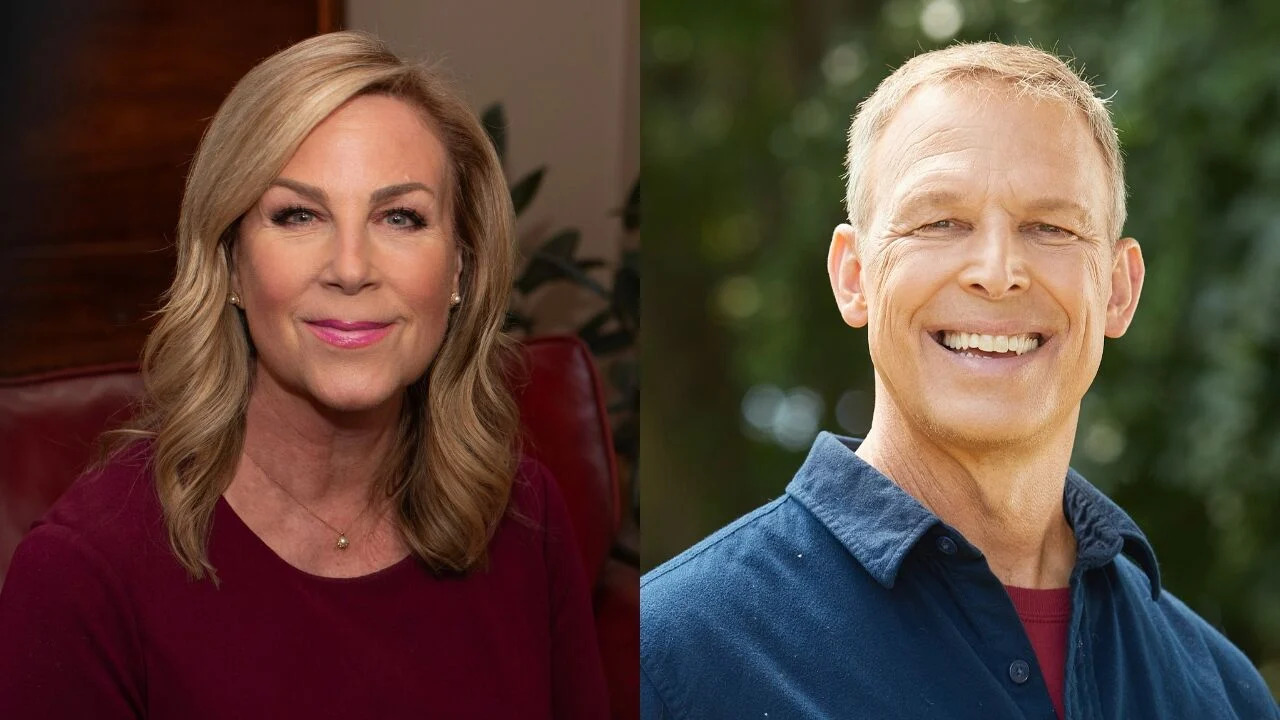
Democrat Janelle Stelson, left, will challenge incumbent GOP Rep. Scott Perry, right, in the race for the the Pennsylvania 10th Congressional District in 2026.
Headshots courtesy Stelson and Perry campaigns / Courtesy of Janelle Stelson for Congress // Scott Perry for Congress
As the democracy reporter for WITF, I will cover any kind of story that has to do with how we govern ourselves. That will include doing a lot of election coverage about how to access the ballot, how public officials administer elections, the technology used to run and secure elections, and the laws that govern it all.
My work will also include accountability coverage for elected officials that use their positions to then undermine democratic institutions, like the legislators that voted against the certification of the presidential election results on January 6, 2021. If that weren’t enough, I foresee covering some local government decisions, fights over public records and transparency, and some candidate coverage around the major elections. As seen in my coverage of immigrant of LGBTQ+ communities, I also report on the consequences of elections for minority groups.
Headshots courtesy Stelson and Perry campaigns / Courtesy of Janelle Stelson for Congress // Scott Perry for Congress
Democrat Janelle Stelson, left, will challenge incumbent GOP Rep. Scott Perry, right, in the race for the the Pennsylvania 10th Congressional District in 2026.
Within the first four minutes of the debate, the candidates established their strategies.
Democratic challenger for the 10th district congressional seat Janelle Stelson focused on incumbent Republican Congressman Scott Perry’s votes for unfavorable policies while remaining vague on her own policy proposals.
In turn, Perry aggressively reframed his positions, sometimes by making inaccurate claims, and repeatedly called Stelson incompetent and a liar.
The debate’s opening question from abc27’s Dennis Owens focused on the War on Iran and rising oil and diesel prices.
Stelson said she thinks the war should end almost immediately, but did not say how, then pivoted to how the rising diesel costs are squeezing local farmers.
“Our farmers have to harvest when they have to harvest. They can’t wait until the cost goes down like other people can,” Stelson said, before decrying the high cost of gas for everyone. “But the farmers especially, the diesel is killing them. A lot of them were already struggling to get food on our tables in a timely fashion. We want to do more to make life affordable for our farmers and everybody else.”
Perry, a retired brigadier general in the Army National Guard who deployed to the Middle East, said he had “dealt with Islamic murderers up close and personally.” He said Iran credibly threatened nuclear war — U.S intelligence shows their nuclear program is not weaponized — and that Iran has “killed or maimed tens of thousands of Americans.” Perry’s campaign made similar claims in response to a WITF questionnaire and provided a link to the Foundation for Defense of Democracies, but the article did not back up Perry’s claim, and WITF could not otherwise find supporting evidence.
Perry also blamed Russia’s war on Ukraine for high diesel prices, pivoting away from the unpopular War on Iran stared by President Donald Trump on Feb. 28.
“Diesel prices have nothing to do with Iran. They have to do with Ukraine and Russia, which shows how incompetent she is about this subject,” Perry said of Stelson.
A recent fact-check from the BBC explains the Middle East is a major hub for diesel production. While both wars have disrupted diesel markets, there has been a greater drop in diesel exports from the Middle East since the start of the War in Iran.
In her rebuttal, Stelson claimed Perry was inconsistent on his stance about whether the U.S. previously wiped out Iran’s nuclear program. WITF was not able to find any such statements from Perry, but that is a claim Trump made after a bombing campaign in June 2025, which his administration has since backpedaled.
The back-and-forth set the pace for the rest of the hour-long debate, which escalated three times to the candidates shouting directly at each other until the moderator intervened.
After an exchange on the impact of the One Big Beautiful Bill on rural hospitals, Perry disagreed with Stelson’s characterizations.
“She’s lying or she’s incompetent. That’s not how Congress works,” Perry said.
Stelson responded, “I’m just talking about your voting record, sir. If you don’t like it, you should get a different job.”
The candidates turned to each other and started speaking at the same time, lobbing accusations.
“Please speak into the microphones, into the camera, not to each other,” Ownes said.
Perry has represented the area since 2013. In his first three elections, he was in a solidly Republican district, but since the state supreme court redrew maps to be more politically balanced in 2018, Perry has faced increasingly close races against Democratic challengers.
In 2024, Perry beat Stelson by 1.3% of the vote, or about 5,000 votes. It was one of the closest congressional races in the country. It is, again, projected to be neck and neck.
But political winds seem to be blowing in Democrats’ favor. National polling all the way down through statewide polls and voter opinion in the 10th district shows people are upset about inflation, which continues to grow. Pennsylvanians broadly blame Republican policies under Trump for the economic woes, according to a series of polls from Franklin & Marshall College. Meanwhile, Pennsylvania is led by a popular incumbent Democratic governor, Josh Shapiro, who will appear at the top of the ballot.
Wednesday’s debate was the only chance for Perry and Stelson to appear on stage together. National competition to control the U.S. House is also expected to be neck and neck, with the 10th district race seen as a key win for either party.
The debate spanned housing and healthcare costs, regulating data centers and artificial intelligence, supporting farmers, election security, and immigration enforcement. The candidates used the live, televised opportunity to disparage each other while trying to encourage their own bases to turn out. Relatively few voters were still undecided before the debate, per Franklin & Marshall data, meaning the debate was likely more about the candidates firing up their supporters to actually cast ballots.
Perry did reveal an investigation in Dauphin County into suspicious voting materials, though he misstated the facts.
Two weeks ago, Dauphin County’s elections director identified and reported to law enforcement 10 suspicious mail ballot applications turned in by a group organizing to increase voter turnout.
As of Oct. 8, county law enforcement found an individual who admitted to filling out the applications with false information, according to county elections director Chris Spackman.
During the debate, Perry incorrectly referred to ballots rather than applications.
“In Dauphin County, just last week, we had ballots that were turned in that were forged,” Perry said.
The applications for mail ballots were rejected, Spackman said. No ballots were delivered to the people associated with those applications.
Counties cannot open returned mail ballots until Election Day, Nov. 3. No review of ballots has occurred at all.
Perry’s campaign was not immediately available for comment. WITF’s attempts to reach Perry directly were not successful.