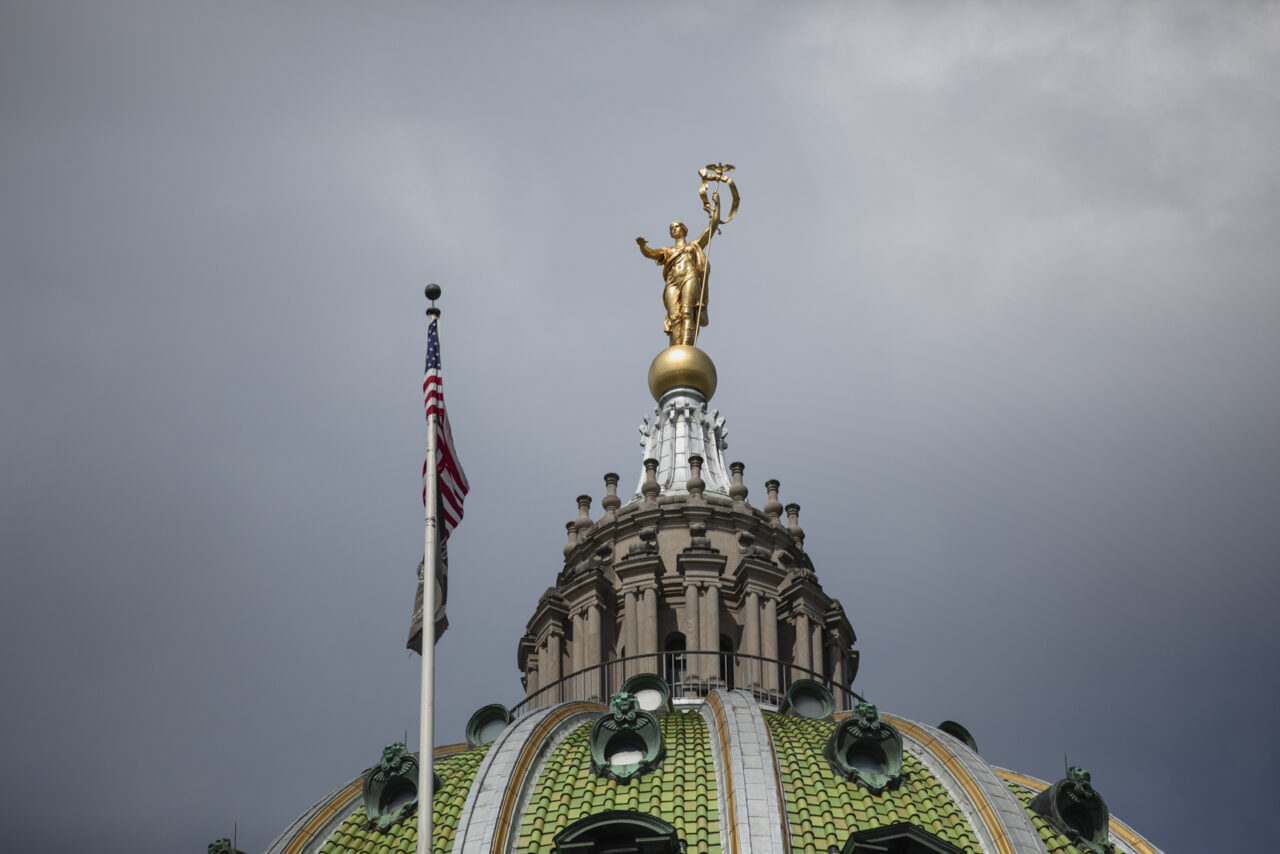
Pennsylvania State Capitol building in Harrisburg on July 26, 2023. (Amanda Berg / For Spotlight PA)
Amanda Berg / Spotlight PA

Pennsylvania State Capitol building in Harrisburg on July 26, 2023. (Amanda Berg / For Spotlight PA)
Amanda Berg / Spotlight PA
Amanda Berg / Spotlight PA
Pennsylvania State Capitol building in Harrisburg on July 26, 2023. (Amanda Berg / For Spotlight PA)
Democratic incumbent Gov. Josh Shapiro is trying to win reelection on his way to a widely anticipated 2028 run for president. State Treasurer Stacy Garrity is his Republican challenger trying to become Pennsylvania’s first woman to lead the Keystone State from the governor’s mansion.
On Wednesday night, abc27 hosted the first and only gubernatorial debate this year, and the first since 2018. The candidate made prominent statements on key political issues that will shape Pennsylvania for years to come and could help — or haunt — the political futures of Shapiro and Garrity.
To help break down what every Pennsylvanian needs to know during the debate, WITF spoke with a panel of journalists following state politics, including WITF’s own Haley O’Brien, Spotlight PA’s Kate Huangpu, and the Philadelphia Inquirer’s Gillian McGoldrick.
This transcript has been edited for concision and clarity.
JORDAN WILKIE: What is the state of play in this race? What do the public opinion polls tell us?
GILLIAN MCGOLDRICK: Heading into the night, Governor Josh Shapiro had a pretty stunning advantage in public opinion polls. A Quinnipiac poll published on Wednesday showed that Shapiro has a 25-point advantage over Garrity while Treasurer Stacy Garrity, has struggled to fundraise. She’s not on TV while Governor Shapiro is spending millions of dollars each week out of his $60 million war chest.
JORDAN WILKIE: Let’s talk about money. What is the picture of how much money these candidates have in their coffers?
HALEY O’BRIEN: Shapiro has raised a lot more than Garrity at this point. Since the beginning of last year, the Shapiro campaign raised more than $55 million, and the Garrity campaign had raised just over $5 million.
JORDAN WILKIE: If Garrity pulls out a major upset victory, she will be the first woman to lead Pennsylvania from the governor’s mansion. But during the debate last night, the real elephant in the room was Shapiro’s political ambitions. What is Shapiro aiming for and how does that play into this race?
KATE HUANGPU: There’s been a lot of speculation and great reporting about how Shapiro has his eye on the presidential race in 2028. Shapiro might leave halfway through his term.
JORDAN WILKIE: Let’s talk about data centers. Garrity and Shapiro have moved away from their initial stances of pro-economic-growth mindset toward data centers. As public sentiment swung harshly against data center development, so have these politicians. Shapiro said he put in place the strictest guardrails on data center development in the country. Is that accurate?
GILLIAN MCGOLDRICK: His argument is that it’s the strictest guardrails in the country because it actually has rules for how these data centers can be developed versus other states like New York that have moratoriums where there’s no guardrails at all, they are just entirely stopped.
JORDAN WILKIE: What are the limitations of what a governor can do? What’s the role of the legislature?
KATE HUANGPU: Notably, Shapiro’s guardrails are voluntary. He can’t change the law. He needs a legislature to actually enact regulations. Neither Shapiro nor Garrity are going to be able to wholeheartedly regulate data centers without the consent of the legislature.
JORDAN WILKIE: National politics loomed large in last night’s debate. People are upset by high gas prices, which are now driving up the cost of goods that must be delivered around the country. Shapiro blamed President Donald Trump’s taxes on imports and his war in Iran. Garrity was stuck, like many Republicans, between not backing unfavorable policies at the national level and also showing allegiance to a president that has really taken control of the Republican Party. What can we learn from Garrity about the tough spot that she and other Republicans are in in this midterm?
KATE HUANGPU: The party that’s not in control of the White House typically does better in the midterm, so Garrity is already at a disadvantage. She was trying not bash the One Big Beautiful Bill Act, work requirements for obtaining Medicaid, Trump’s tariffs, and the war in Iran. At the same time, she tried to distance herself from RFK Jr. She was trying to walk that line of nominally defending Trump while also saying she’s different from this administration.
GILLIAN MCGOLDRICK: Treasurer Garrity distancing herself from Trump was fascinating. I’ve been following her since the beginning of her campaign last year. This is the most I’ve seen her try and step back. It was pretty nominal but it was significant.
JORDAN WILKIE: Governor Shapiro is the most prominent Jewish politician in Pennsylvania and one of the most prominent Jewish politicians in the country. Wednesday was the anniversary of the October 7th attack when Hamas militants killed or kidnapped nearly 1,200 Israelis and several Americans and injured, harmed, or sexually assaulted many more. In the three years since, Israel has killed more than 70,000 Gazans, including more than 20,000 children, and has destroyed eight out of ten buildings, including hospitals, schools, and homes in Gaza. That’s according to the United Nations, which has also commissioned investigations that have found Israel is likely committing genocide. That war and U.S. support for Israel is deeply unpopular, particularly among the Democratic base and a growing wing of an isolationist wing of the Republican Party. Governor Shapiro has aspirations for higher office. How does his stance on Israel affect what he wants to do next?
GILLIAN MCGOLDRICK: He really had to face it last night in a question that he received from the moderators. A recent poll found 60% of likely Democratic voters in Pennsylvania do not want the U.S. to provide economic and military support to Israel. Shapiro reiterated his support for Israel. He will need to rectify this once he gets into 2028, as it is something that is growing unpopular among Democratic voters who will decide in a Democratic primary.
JORDAN WILKIE: There was some confusion during the debate around how much money the state actually has in reserve, and it seemed like both of candidates were saying the same thing but defining it quite differently. Is the budget balanced or not?
KATE HUANGPU: The state is supposed to have a balanced budget. One could view that as saying that we spend as much as we take it in taxes and revenue. But we really don’t ever do that. We always find extra money from one place or another. And in the past few years, that extra money has come from surplus in the general fund and surplus in the rainy day fund. The rainy-day fund, which is what we’re taking from now, is meant to be in case of emergency, like Treasurer Garrity said, in case of an economic downturn. But from Shapiro’s perspective, he’s saying, oh, well, we can dip into it. It’s a surplus still. It’ll be fine. It’s one of those political mass equations where it just depends on your perspective.
JORDAN WILKIE: No matter who wins in the gubernatorial race and who wins in the state House and state Senate, they’re going to have to govern. We hope. We hope! What is the issue that no matter who’s in office, they’re going to have to deal with it in one way or another?
HALEY O’BRIEN: I’m watching data centers and utility rates. They’ve gone up a lot this summer, and the increased demand for power is expected to make them go up even more.
KATE HUANGPU: I think the thing they could probably maybe push over the edge is skill games. There’s been a lot of agreement and somewhat consensus that there needs to be something happening. It’s those finer details that need to be ironed out.
GILLIAN MCGOLDRICK: The state budget. It’s not that sexy, but having to balance that budget every year will definitely be the biggest challenge.

Member support provides the foundation we rely on to connect our community with trusted journalism. Support WITF’s Fall Membership Campaign today.