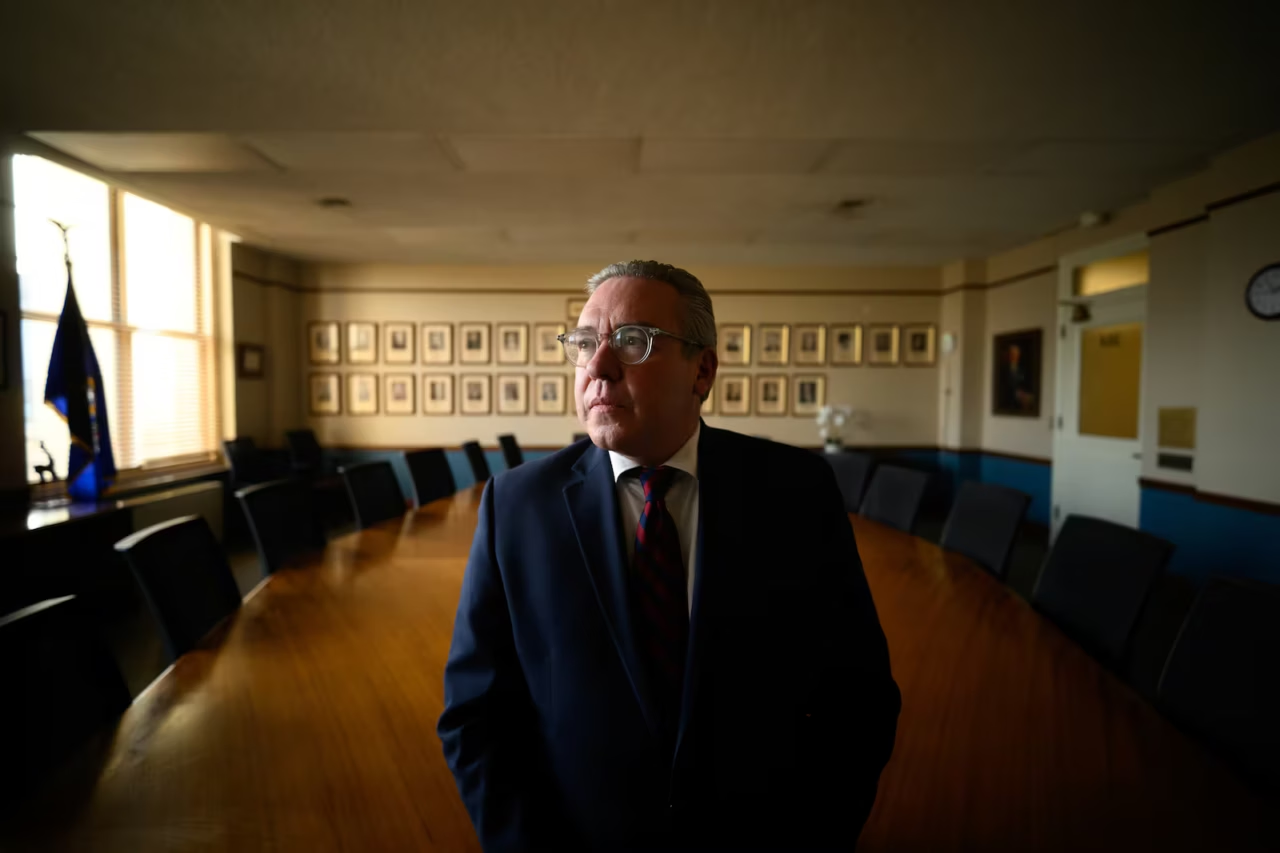
Pennsylvania Secretary of State Al Schmidt sits for a portrait in a Department of State conference room at the capitol Harrisburg, Pa. on December 17, 2024. As a city commissioner in Philadelphia, Schmidt uncovered hundreds of noncitizens registered to vote. (Kriston Jae Bethel for Votebeat)
As the democracy reporter for WITF, I will cover any kind of story that has to do with how we govern ourselves. That will include doing a lot of election coverage about how to access the ballot, how public officials administer elections, the technology used to run and secure elections, and the laws that govern it all.
My work will also include accountability coverage for elected officials that use their positions to then undermine democratic institutions, like the legislators that voted against the certification of the presidential election results on January 6, 2021. If that weren’t enough, I foresee covering some local government decisions, fights over public records and transparency, and some candidate coverage around the major elections. As seen in my coverage of immigrant of LGBTQ+ communities, I also report on the consequences of elections for minority groups.
Kriston Jae Bethel, Votebeat / Votebeat
Pennsylvania Secretary of State Al Schmidt sits for a portrait in a Department of State conference room at the capitol Harrisburg, Pa. on December 17, 2024. As a city commissioner in Philadelphia, Schmidt uncovered hundreds of noncitizens registered to vote. (Kriston Jae Bethel for Votebeat)
Pennsylvania’s top election official says the federal government is trying to illegally change election rules. Al Schmidt leads the Department of State, which has a limited oversight role for the elections run by each of Pennsylvania’s 67 counties.
He says despite the national news of President Donald Trump’s executive order and the back-and-forth legal battle over whether – and how – people could vote by mail, nothing has changed in Pennsylvania, pending decisions by the higher courts.
“The Department of State remains committed to ensuring another free, fair, safe and secure election this November and fighting any unlawful federal overreach into our elections,” Schmidt said during a news conference on Wednesday.
A federal judge blocked plans by the United States Postal Service to put in place strict rules that would severely limit by-mail voting. The USPS made their new policies in response to Trump’s March executive order meant to “protect the integrity of the mail as a medium for transmitting Federal election ballots.”
This is the second round of injunctions on USPS adding restrictive rules about delivering mail-in ballots after the U.S. Supreme Court decided the first injunction came before any rules were actually violated. Gov. Josh Shapiro, along with 22 other states and the District of Columbia, sued again at the end of August.
In the federal government’s appeal to the new injunction, USPS argues its new by-mail rules are “modest reporting and design requirements,” and that claims from that the federal government intends to seize control of election administration are false.
The U.S. Supreme Court will again in coming days or weeks decide if the president’s new rules can remain blocked for the midterm elections. North Carolina has already sent out mail-in ballots, while Pennsylvania is beginning the process of sending ballots to overseas and military voters in remote locations. States claim that implementation of the federal rules would interfere with the way tens of millions of Americans cast ballots, while the federal government claims the hurdles to implementation are overblown.
In his briefing, Schmidt also said one of his biggest concerns is the spread of false information about voting and gave an example of the federal government spreading unsupported information.
Back in July, President Trump made a live national address about his proposals for changes to election laws, and the head of the Department of Homeland Security followed up to Pennsylvania with a letter claiming 14,000 non-citizens were registered to vote in the state.
DHS has not explained how they got to that number, Schmidt said Wednesday. The Pa. Department of State cannot take action on removing people from the rolls if there isn’t evidence to show they are ineligible.
“We have communicated this to DHS several times and still do not have anywhere near sufficient information to act on what they have claimed,” Schmidt said. “To date, all we have are unsupported accusations in a letter.”
He says relying on bad methods can lead to inaccurate results and false claims about the legitimacy of voters.
According to a letter Schmidt sent to the federal government last month, DHS officials say they don’t have high confidence in their own numbers. To date, the federal government has not recanted its claims about high numbers of non-citizens registered to vote, nor has it given evidence for its claims.
Schmidt also said several counties need more people to work the polls. Every Pennsylvania election requires about 45,000 poll workers across 9,000 polling places, he said.
“It’s a great way to learn about how elections work and to serve your community,” Schmidt said. “Counties provide training and pay poll workers for their time in training and at the polls on Election Day.”