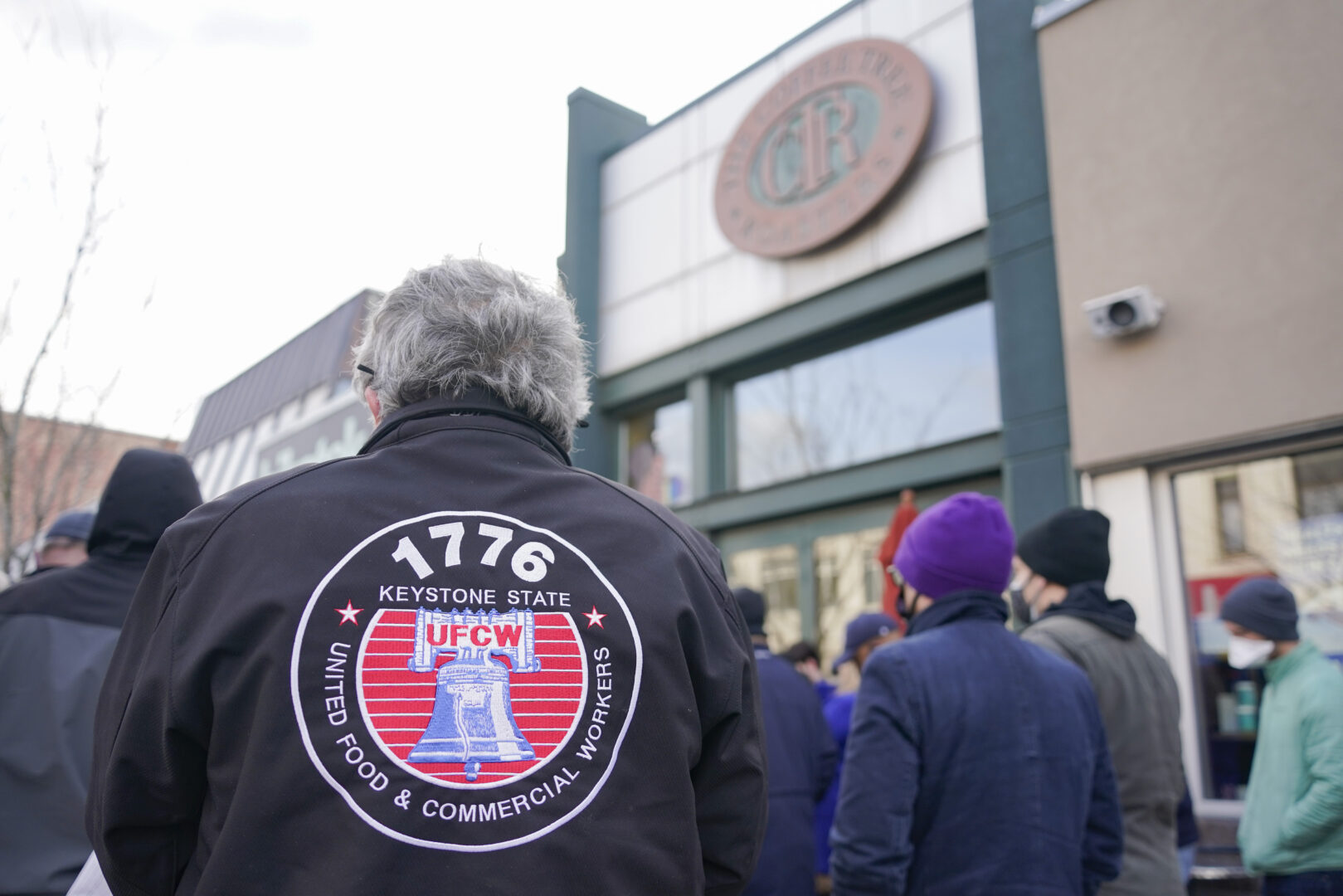
Union officials and local politicians hold a rally supporting unionization efforts at a coffee shop in Pittsburgh's Squirrel Hill neighborhood. (AP Photo/Keith Srakocic)
AP Photo/Keith Srakocic

Union officials and local politicians hold a rally supporting unionization efforts at a coffee shop in Pittsburgh's Squirrel Hill neighborhood. (AP Photo/Keith Srakocic)
AP Photo/Keith Srakocic
AP Photo/Keith Srakocic
Union officials and local politicians hold a rally supporting unionization efforts at a coffee shop in Pittsburgh's Squirrel Hill neighborhood. (AP Photo/Keith Srakocic)
At a time when opinion polling shows Americans’ number one concern is the economy and cost of living, organized labor is at an inflection point. Union membership has been on a steady decline since Ronald Regan was elected president in 1980, according to Paul Clark, a Penn State professor who studies and teaches about unions.
That’s had consequences for blue collar laborers.
“Over the last 50 years or so, the pay of workers at the lower end of the pay scale has not improved really at all compared to inflation,” Clark said.
That’s, in part, because “the labor movement over the last 30 years has been beaten down by employers,” Clark said.
Membership is down to 10% of American workers, compared to around 35% in the heyday of organized labor in 50s, 60s, and 70s.
The decline is even evident in union states like Pennsylvania, which boasts the first union and first state right to strike, as well as the first court case against unions and executions of unionizers. Federal data shows that in 2025, 11.7% of Pennsylvania workers were represented by unions, down from 25% in 1985.
A more complete timeline of Keystone State labor can be found at the Pa. Labor History Society’s website.
But the tide might be turning. An August opinion poll from Gallup shows unions have more public support than at any time in the last 25 years, with 47% of Americans saying they want unions to have more influence.
On this Labor Day, Clark said there are parallels between now and the late 1800s when employers still called the shots and were backed by the federal government.
The first “Labor Day” march was in 1882 in New York City and has continued ever since.
The federal holiday was created only after the federal government sided with employers to crush the Homestead Strike in Pennsylvania (1892) and the Pullman Strike across the Midwest (1894). As an olive branch, then-President Grover Cleveland created Labor Day as a federal holiday.
Low-wage laborers kept organizing but unions remained disadvantaged in power until the Great Depression, during which President Franklin D. Roosevelt pushed through the National Labor Relations Act that established worker rights and federal enforcement — a major role reversal for the executive branch.
Since, unions were able to win protections and benefits that spread across the workforce.
“Unions brought in the eight-hour day and the 40-hour week, and the weekend, they brought in later health insurance and pensions,” Clark said. “Those did not appear on the scene because employers just decided, gee, we should give our workers some days off.”
President Joe Biden said he wanted to be the most pro-union U.S. president in history, and Clark says he largely succeeded. Biden strengthened the National Labor Review Board and worker protections at a time when the country was seeing major unionization and bargaining efforts with laborers in car plants, Amazon workers and Starbucks baristas.
But the story is very different under President Donald Trump.
“The Trump administration is doing everything they can to keep those workers from organizing a union and having any power. That’s exactly what the governments back in the 1800s did,” Clark said.
Now, unlike then, the federal government has not sent federal troops in to end strikes. But Trump fired NLRB board members, and the U.S. Supreme Court agreed he had the power to remove them from the formerly independent agency.
Clark said he is waiting to see if Trump will be successful in quashing recent labor gains, or if organizers are at the start of a new movement.
Update: This story initially had a typo in the timeline. The first union was formed in the United States in 1794, not 1974.

Member support provides the foundation we rely on to connect our community with trusted journalism. Support WITF’s Fall Membership Campaign today.